The difference between grand pianos and uprights
November 5th, 2008
If you’re new to playing the piano and are looking to purchase one, you might be confused about the differences between an upright and a grand, and therefore don’t know which piano would be the better suited for your lifestyle. And, aside from the pure aesthetics of the piano, there are other essential differences between a grand and an upright.
Most professional pianists play a grand piano because typically the sound quality is better. Although a grand piano is a large instrument, there’s a reason for its size that isn’t just about visual appeal. Because the frame extends horizontally, there’s room to place the strings in the same direction. The longer strings are the reason for the improved sound in a grand piano. Shorter, thicker strings (such as those in an upright or a baby grand piano) produce more inharmonicity in their sound.
When any instrument is played, the single notes created have a distinct pitch. But, these pitches can contain partial tones apart from the played note, which are known as inharmonicity. A grand piano has more elasticity in its strings (as there is more room in the piano’s frame for them), and thus has a lower degree of inharmonicity and therefore produces a purer sound.
Baby grand pianos have the same horizontal layout as a grand piano, but are smaller in scale, (they’re often shorter than they are wide). While the sound of a baby grand is not equal to a grand piano, if you have space constraints they can be a good choice.
In addition, all grand pianos (including baby grands) have repetition levers in each of their keys. The repetition levers enable pianists to play staccato, trills and repeated notes with greater control and speed. Unfortunately, upright pianos do not have these repetition levers, so you won’t be able to achieve the same playing versatility that you can on a grand piano.
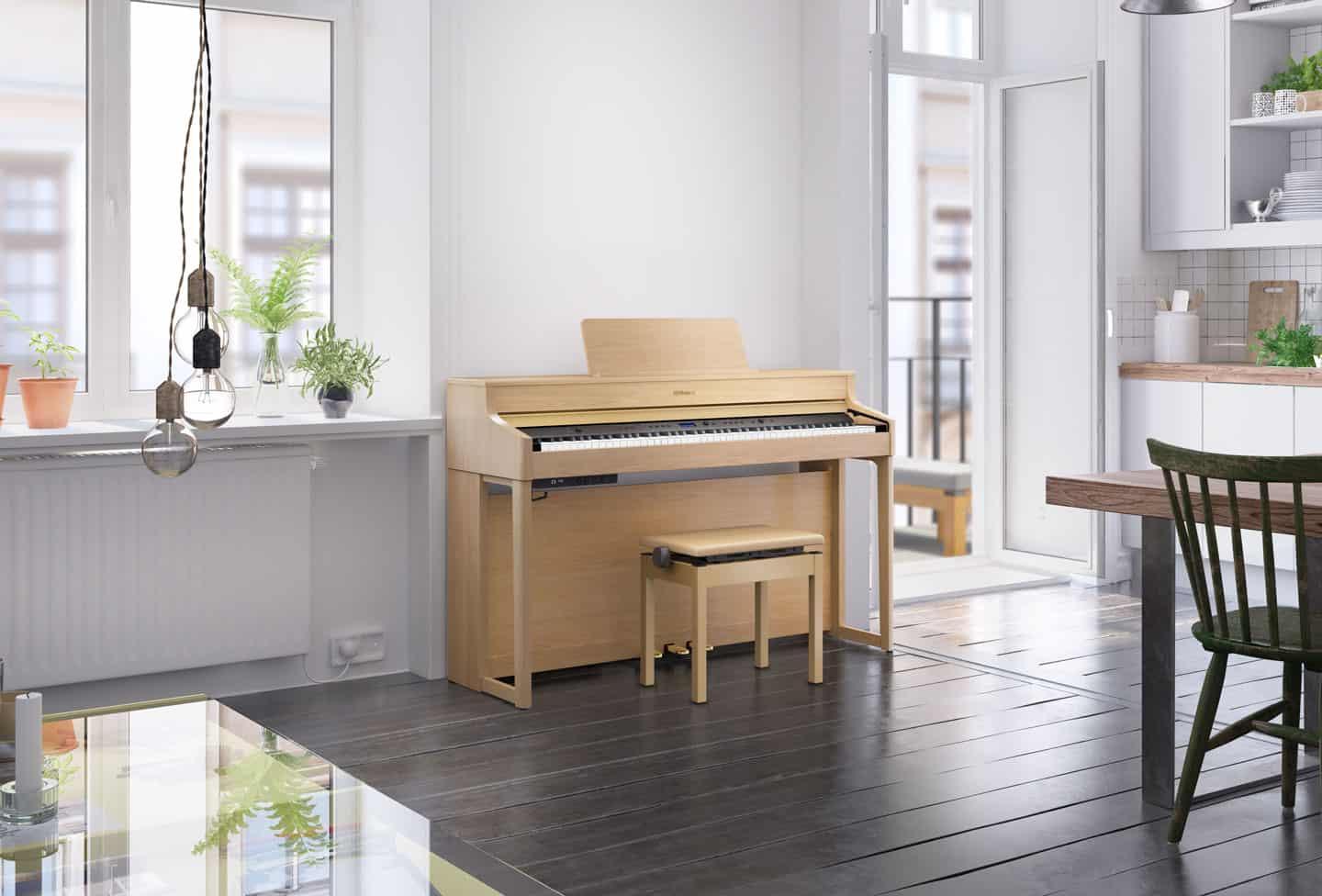
Completely opposite from the grand piano, an upright piano’s frame and strings sit vertically. For people with limited space available, an upright piano might be the better choice as it takes up a lot less room than a grand piano.
Unlike a grand piano, where the sound is produced from the top, an upright piano’s sound comes from the back of the piano. Because the strings are placed vertically, an upright piano depends on the use of springs to make the strokes when playing. Since a grand piano has the benefit of gravity, one is less likely to get irregular responses from the piano while playing, and notes can be played faster. The springs on an upright can wear out over time and thus produce a less reliable sound. However, if the piano is looked after, they keys should continue to produce the music properly that you’re playing.
It can be hard to choose between an upright and a grand piano. Although the sound is better on a grand piano, sometimes there just isn’t enough space for one in your home, and an upright is the better choice.